Complete Tuscany guide
San Gimignano: things to do, medieval towers, parking and itineraries
Published: Updated:
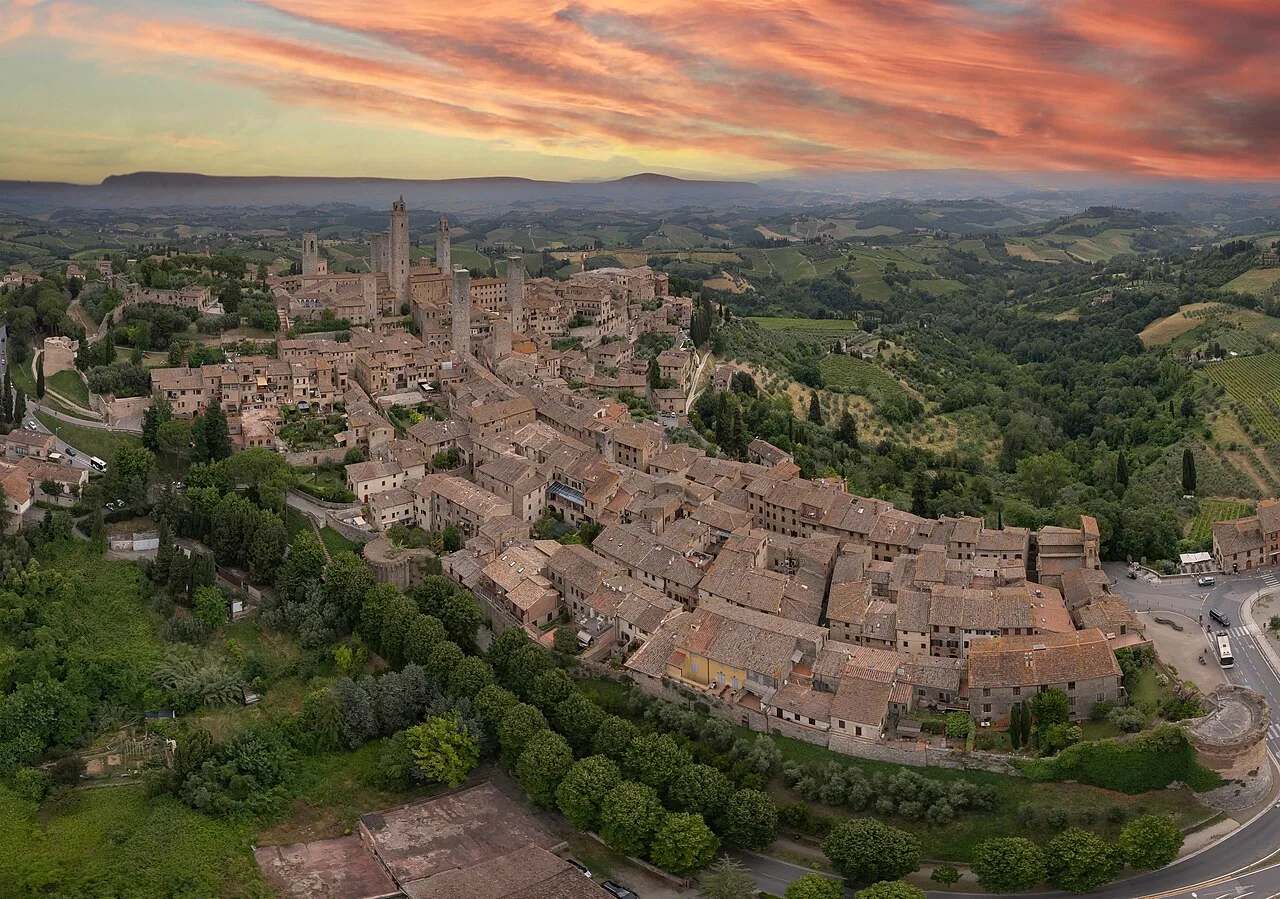
San Gimignano is the Tuscan medieval town famous for its tower-filled skyline. Allow at least half a day; with a full day you can climb Torre Grossa, see the Cathedral and museums, explore quieter streets and taste Vernaccia. This guide puts every stop in a practical order and includes parking, timings and realistic alternatives.
San Gimignano at a glance
| Province | Siena, Tuscany |
|---|---|
| Area | Val d’Elsa, on the Via Francigena |
| Historic centre | ZTL restricted zone; park outside the walls |
| From Perla Toscana | About 62 km, normally around 1 hr 10 min |
| From Florence | About 55–60 km, normally 1 hr–1 hr 20 |
| From Siena | About 40–45 km, normally 45–55 min |
Why visit San Gimignano
San Gimignano brings towers, civic palaces, squares, frescoes and views together in a compact walkable centre. Its medieval street plan remains exceptionally clear: this is not merely a photogenic backdrop, but a town where family power, civic life, religious art and trade can still be read in the buildings.
It is an excellent first Tuscan medieval town, a manageable day out for families and a natural combination of culture, landscape and wine.
A short history of the medieval town
Its position on the Via Francigena encouraged pilgrims, merchants and trade. San Gimignano became an independent commune in 1199. Between the 11th and 13th centuries, powerful families built fortified tower houses as symbols of wealth and influence. UNESCO estimates there were probably about 72; 14 survive.
After famine and plague, the town came under Florence in 1353. Its later economic decline limited rebuilding and helped preserve the urban fabric that UNESCO recognised in 1990.
The medieval towers of San Gimignano
The towers were parts of fortified family homes, not simply viewpoints. The best-known include Torre Grossa, Torre Rognosa, Torre del Diavolo, the Salvucci towers and the Ardinghelli towers.
| Tower | Location | Why it matters |
|---|---|---|
| Torre Grossa | Town Hall | 54 m; main climbable tower and highest viewpoint |
| Torre Rognosa | Piazza del Duomo | Historic tower of Palazzo del Podestà |
| Torre del Diavolo | Piazza della Cisterna | Named after a legend about its height |
| Salvucci towers | Near Piazza del Duomo | Twin towers of a powerful Guelph family |
| Ardinghelli towers | Piazza della Cisterna | Twin towers linked to their Ghibelline rivals |
Piazza della Cisterna
This triangular square takes its name from the medieval cistern at its centre. Palaces and tower houses surround it, including Torre del Diavolo and the Ardinghelli towers. Visit early for space and soft light; midday is usually the busiest period.
Piazza del Duomo
The monumental heart of town contains the Collegiate Church, Town Hall and Torre Grossa, plus Palazzo del Podestà and Torre Rognosa. Walk around the whole square before entering: its changing viewpoints explain the relationship between religious, civic and family power.
The Cathedral or Collegiate Church
The “Duomo” is technically a collegiate church. Its interiors preserve major fresco cycles: Old and New Testament scenes, Taddeo di Bartolo’s Last Judgment and the Santa Fina Chapel associated with Domenico Ghirlandaio.
In 2026 the official full-price ticket is €5. Seasonal opening hours can change for liturgical services, and last admission is normally 30 minutes before closing. Check on the day.
Town Hall and Torre Grossa
Palazzo Comunale houses the Civic Museums, art gallery and frescoed rooms such as Sala di Dante. The 54-metre Torre Grossa provides the classic high view of the town and countryside.
The climb involves many stairs and can be demanding in heat or crowds. Visitors with limited mobility or vertigo can choose Rocca di Montestaffoli as an outdoor alternative.
Which museums to visit
- Civic Museums: Town Hall, art gallery and Torre Grossa; the priority for a first visit.
- Sacred Art Museum: complements the Collegiate Church.
- Archaeological Museum: explains the area’s Etruscan and Roman roots.
- Santa Fina Pharmacy: explores historic medicine and care.
- Modern and Contemporary Art Gallery: best for a longer stay.
With half a day, choose one complex. With a full day, combine Civic Museums and Cathedral. Confirm which attractions are included in the current San Gimignano Pass.
Rocca di Montestaffoli
Only parts of the 14th-century fortress remain, but its green space and views make it essential. From the walls you can frame towers, roofs, vineyards and the Val d’Elsa hills. It is especially attractive in late afternoon; irregular surfaces and slopes require care.
Best panoramic viewpoints
- Torre Grossa: highest and most complete view.
- Rocca di Montestaffoli: best free alternative.
- Via degli Innocenti: quieter views towards walls and countryside.
- Walk along the walls: connects town and landscape.
- Roads outside town: use only safe lay-bys; never stop in the carriageway.
The best walking itinerary
| Stop | Typical time | Purpose |
|---|---|---|
| Porta San Giovanni and Via San Giovanni | 20 min | Scenic entrance |
| Piazza della Cisterna | 20–30 min | Urban form and towers |
| Piazza del Duomo | 15 min | Monumental centre |
| Collegiate Church | 45–60 min | Fresco cycles |
| Town Hall and Torre Grossa | 60–90 min | Civic art and panorama |
| Rocca di Montestaffoli | 30–45 min | Towers and vineyards view |
| Via San Matteo and Sant’Agostino | 45–60 min | Quieter streets and frescoes |
What to see in half a day
- Enter through Porta San Giovanni.
- Walk to Piazza della Cisterna and Piazza del Duomo.
- Choose one paid attraction: Cathedral or Torre Grossa.
- Continue to Rocca di Montestaffoli.
- Return along Via San Matteo or the walls.
Allow a realistic 4–5 hours including short waits.
San Gimignano in one day
| Time | Suggested plan |
|---|---|
| 08:45 | Park before tour groups arrive |
| 09:00–10:00 | Main street and both central squares |
| 10:00–11:00 | Collegiate Church |
| 11:15–12:30 | Town Hall and Torre Grossa |
| 12:45–14:00 | Lunch or a light tasting |
| 14:00–15:00 | Via San Matteo and Sant’Agostino |
| 15:15–16:00 | Rocca di Montestaffoli |
| 16:00–17:30 | Walls, shops and optional second museum |
Where to park in San Gimignano
The historic centre is a ZTL restricted zone. Four main municipal visitor car parks sit outside the walls.
| Car park | Side and capacity | 24-hour maximum | Best use |
|---|---|---|---|
| P1 Giubileo | South · 305 spaces, 5 accessible | €7 first day | Best value for a long stay; a few hundred metres away and served by citybus from April to October |
| P2 Montemaggio | South · 153 spaces, 4 accessible | €15 first day | Convenient for Porta San Giovanni; fills quickly |
| P3 Bagnaia Superiore | North · 90 spaces, 9 accessible | €15 first day | Useful from the north and for Via San Matteo |
| P4 Bagnaia Inferiore | North · 231 spaces | €15 first day | A higher-capacity alternative to P3 |
These are the tariffs published on the municipal page updated 25 June 2026 and apply to the first consecutive day. Separate overnight maximums apply. Prices, availability and services may change, so check the official live status before joining a queue.
How to reach San Gimignano
By car
There is no motorway exit in town. From Florence, use the Florence–Siena road, leave around Poggibonsi and continue on local roads. From Siena, follow the same corridor north. Enter the chosen car park in navigation, not Piazza del Duomo.
By public transport
San Gimignano has no railway station. Travel normally involves a train to Poggibonsi and a bus connection. Check current regional timetables and Sunday service. A car is more flexible from Perla Toscana.
Best time to visit
- April–May: comfortable weather; holiday weekends are busy.
- June: long days, events and attractive countryside.
- July–August: hottest and busiest; arrive before 9.
- September–October: harvest season and warm colours.
- November–March: quieter atmosphere but shorter hours and closures.
A weekday outside peak season offers the best balance.
Events
The programme changes annually and may include medieval celebrations, cultural festivals, concerts, markets and wine events. Events can alter traffic, parking and monument hours. Use the municipal calendar for the actual year rather than relying on an old article.
Where to eat
The centre has restaurants, trattorias, wine bars and quick options. Read the full menu and prices, book at weekends, look beyond the two main squares for quieter tables and choose a wine list with local Vernaccia producers. The driver should not drink.
Local specialities
- San Gimignano DOP saffron in risotto, pasta and traceable packages.
- Vernaccia di San Gimignano DOCG, the area’s signature white wine.
- Cured meats and pecorino, checking origin and maturation.
- Ribollita and soups in cooler months.
- Wild boar and braised meat in inland Tuscan cooking.
Vernaccia di San Gimignano
Vernaccia di San Gimignano DOCG uses grapes grown on the municipality’s hills. The rules require at least 85% Vernaccia di San Gimignano, with authorised non-aromatic white varieties allowed within limits. It is a dry, savoury white with floral, fruit and mineral notes and sometimes an almond finish.
Riserva requires at least 11 months of ageing, including 3 months in bottle. Taste responsibly and appoint a non-drinking driver.
Shopping
- DOCG Vernaccia with producer, vintage and numbered seal visible.
- DOP saffron in sealed, traceable packaging.
- Ceramics and crafts, asking where they were made.
- Books, prints and photography about the medieval heritage.
Never leave wine or delicate food in an overheated car.
Photography tips
- Reach Piazza della Cisterna early.
- Use ultra-wide lenses carefully to avoid distorted towers.
- Frame towers and countryside together from the Rocca.
- Use arches as natural frames without blocking passages.
- For the external skyline, stop only in a safe designated place.
- Late-afternoon light warms stone and brick.
Visiting with children
Turn the day into a tower hunt instead of a sequence of museums. Combine one cultural visit, a square and the Rocca. Pushchairs work on main streets but are awkward on cobbles, slopes and stairs. Consider age, heat and vertigo before climbing Torre Grossa.
Visiting with dogs
The outdoor town works for dogs comfortable with crowds, but museums, churches and towers may restrict entry. Bring water, keep a short lead in busy areas, avoid hot paving and never leave a dog in the car.
Accessibility
Slopes, cobbles, steps and historic buildings create barriers. Torre Grossa requires stairs. Check accessible parking, contact museums and the Cathedral about current routes and consider an adapted visit around Piazza della Cisterna, Piazza del Duomo and the Rocca. Conditions may change during works or events.
Mistakes to avoid
- Setting navigation to Piazza del Duomo and reaching the ZTL.
- Arriving at midday in August expecting a nearby space.
- Assuming every tower can be visited.
- Planning every museum and two tastings in half a day.
- Underestimating stairs, heat and cobbles.
- Using old hours and tariffs without an official check.
- Combining San Gimignano, Siena, Pisa and Chianti in one day.
How long you need
| Available time | Realistic visit |
|---|---|
| 2 hours | Main streets, both squares and Rocca |
| Half day | Centre, one paid monument and panorama |
| 1 day | Cathedral, Town Hall/Torre Grossa, Rocca and Sant’Agostino |
| Weekend | Town at a slower pace, minor museums, winery or Via Francigena walk |
For most first-time visitors, one full day is ideal.
Distance from Florence, Siena and Perla Toscana
| Starting point | Approximate distance | Normal drive |
|---|---|---|
| Florence | 55–60 km | 1 hr–1 hr 20 |
| Siena | 40–45 km | 45–55 min |
| Perla Toscana | About 62 km | About 1 hr 10 |
These are rounded estimates, not guarantees. Check traffic, works and live parking before leaving.
Things to do nearby
- Certaldo Alto: Boccaccio’s hill town.
- Volterra: Etruscan heritage, alabaster and views.
- Monteriggioni: a compact walled village.
- Colle di Val d’Elsa: historic centre and crystal tradition.
- Chianti: villages, scenic roads and booked wineries.
- Pienza and Val d’Orcia: better as a separate day.
Where to stay for San Gimignano and Tuscany
Perla Toscana in Figline e Incisa Valdarno is a base for families and groups alternating Florence, Chianti, Valdarno, The Mall Firenze and a San Gimignano day trip without changing accommodation. The house has an equipped kitchen, shared living space and private parking.
Leave early, give the town a full day and return without adding Siena or Pisa.
FAQ
Frequently asked questions
What should first-time visitors see in San Gimignano?
Walk Via San Giovanni, visit Piazza della Cisterna and Piazza del Duomo, see the Collegiate Church, choose the Town Hall and Torre Grossa, and finish at Rocca di Montestaffoli.
How many towers are there in San Gimignano?
Fourteen medieval towers survive. UNESCO estimates there were probably about 72 at the height of the town’s development.
Which tower can you climb?
Torre Grossa, attached to the Town Hall, is the principal climbable tower. It is 54 metres high and involves many stairs.
How long do you need in San Gimignano?
Allow at least 4–5 hours for the centre, one monument and a viewpoint. A full day is ideal.
Where should visitors park?
The principal visitor car parks are P1 Giubileo and P2 Montemaggio to the south, and P3 and P4 Bagnaia to the north. Check municipal live availability.
Can visitors drive into the historic centre?
The historic centre is a ZTL restricted zone. Visitors should use car parks outside the walls unless specifically authorised.
How much does parking cost?
Prices vary. In 2026 the municipality lists a €7 maximum for the first 24 hours at P1 Giubileo. Check current official tariffs for P1–P4.
How far is San Gimignano from Perla Toscana?
The approximate distance is 62 km, normally around 1 hour 10 minutes by car. Traffic and route choice can change the journey.
What is the best time to visit?
April–May and September–October usually offer comfortable weather. Choose a weekday and arrive before 9 for fewer crowds.
Is San Gimignano suitable for children?
Yes, especially when you combine a tower hunt, one museum and breaks. Pushchairs are less practical on cobbles, slopes and stairs.
Is San Gimignano wheelchair accessible?
The main squares can form part of an adapted route, but slopes, cobbles and historic buildings create barriers. Torre Grossa requires stairs; confirm current access directly.
Which wine is San Gimignano known for?
Vernaccia di San Gimignano DOCG, a dry savoury white made with at least 85% Vernaccia grapes grown within the municipality.
Can you visit San Gimignano and Siena in one day?
It is possible but not recommended for a first visit. Parking, museums and travel make the schedule rushed; one day for each is better.
Book your stay in Tuscany
Discover Perla Toscana, your holiday home near Florence, ideal for families and groups of up to 8 guests.