Route overview
The most coherent route runs from Valdarno through Valdichiana to the upper Tiber valley and La Verna, then crosses Lake Trasimeno towards Assisi. It is not one compulsory road. Walkers can join the official Way of Saint Francis; drivers can use Perla Toscana for La Verna, Castiglion Fiorentino, Cortona and the lake before relocating towards Assisi. Geography matters: seeing fewer places well is better than rushing through a list of sanctuaries.
Why follow Saint Francis
Francis sought secluded places without withdrawing from humanity. Woods, caves and small chapels offered prayer; towns and roads offered encounter. This itinerary therefore moves between silence and art. La Verna preserves the memory of the stigmata, Le Celle and Montecasale reveal the scale of hermit life, and Assisi brings together Francis’s tomb, the Porziuncola, San Damiano and the places of Clare. Travellers of any belief can read medieval landscapes, mendicant architecture and an enduring ideal of simplicity and care for creation.
La Verna Sanctuary
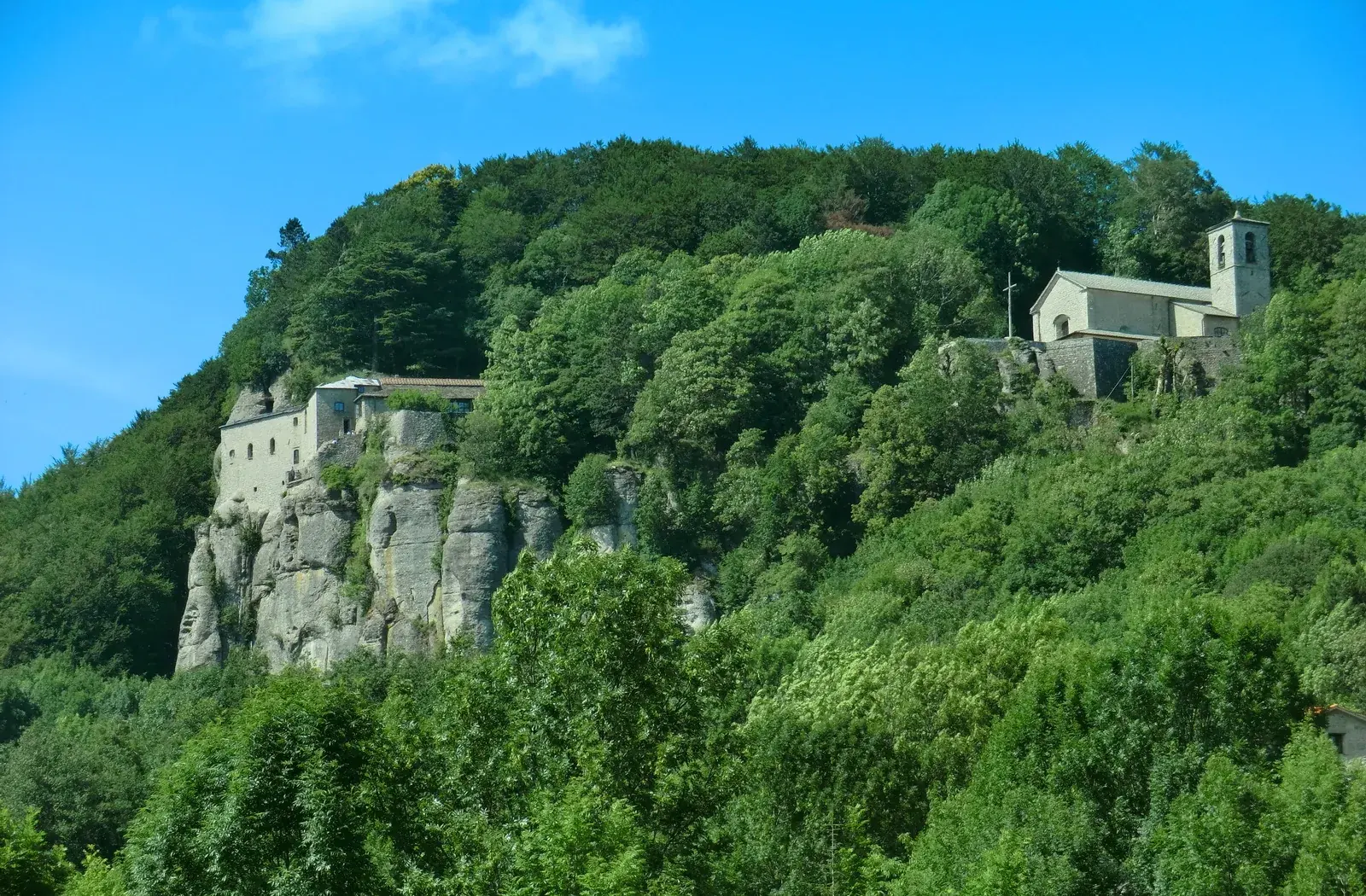
In the Tuscan municipality of Chiusi della Verna, the sanctuary stands on the mountain given to Francis by Count Orlando of Chiusi. Franciscan tradition places the stigmata here in 1224. This is not a single church: the main basilica, Santa Maria degli Angeli, the Corridor and Chapel of the Stigmata and prayer sites among the rocks need three or four hours. The final road climbs into the Apennines; check weather and road conditions in winter. Woodland paths have natural surfaces and gradients, while parts of the historic complex include steps. Check celebrations and access on the official sanctuary website.
Montecasale Hermitage
Montecasale stands above Sansepolcro in Tuscany, on the Alpe della Luna slopes. Originally a place of hospitality, it was entrusted to Francis around 1212–1213 and developed into a lasting Franciscan presence; Capuchin friars care for it today. Its power lies in small spaces: cloister, church, choir, refectory and the memory of welcoming travellers. Combine it with Sansepolcro or place it between La Verna and Umbria, not on an already full Assisi day. Mountain roads require care. Source: Diocese of Arezzo-Cortona-Sansepolcro.
Le Celle and Cortona: distinct Franciscan stories
Le Celle Hermitage, in Cortona, was among the first settlements chosen by Francis. Buildings cling to the ravine above a stream, and the tiny cell associated with him conveys the physical simplicity of hermit life. It remains a religious fraternity rather than a museum; silence and respectful dress matter. See the Capuchin community website.
In Cortona itself, the Church of San Francesco and the hilltop Basilica of Santa Margherita broaden the story. Margaret lived in the following century and became a Franciscan tertiary; she was not Francis’s companion. Her basilica belongs to Cortona’s later Franciscan history, while the direct Francis connection is chiefly Le Celle. The climb is steep, so check parking and access if mobility is limited.
Castiglion Fiorentino and the Tuscan Way
Castiglion Fiorentino is a documented stage on the Way of Saint Francis in Tuscany, linking Florence, Arezzo, Valdichiana, Cortona, the upper Tiber valley and La Verna. Its Church of San Francesco records a Friars Minor presence, but the wider landscape is equally important: parish churches, olive groves and ridge paths show how Franciscan travel connected communities. It is a sensible stop between Perla Toscana and Cortona. We avoid assigning a precise episode from Francis’s life where official sources do not confirm one.
Assisi: Saint Francis and Saint Clare
Assisi needs at least one full day. The Basilica of Saint Francis holds his tomb in the crypt; the Lower and Upper churches contain major cycles of Italian painting. It remains an active place of worship, so services, groups and security may affect timing. Across the sloping historic centre, the Basilica of Saint Clare keeps Clare’s body and the San Damiano Cross central to Francis’s vocation. Wear stable shoes and keep the timetable light. Check the official sites for the Basilica of Saint Francis and Saint Clare.
San Damiano, the Carceri Hermitage and Rivotorto
San Damiano, below the walls, joins the story of the cross that spoke to Francis with Clare’s long life there. The walk from town is steep and the rooms are small. The Eremo delle Carceri on Mount Subasio is a retreat among holm oaks, caves and paths; its name means seclusion, not a prison. The road is narrow and weather and footwear shape the visit. In the plain, Rivotorto preserves the memory of the shelter where the first fraternity lived together. It is less monumental but crucial to understanding the movement’s beginnings. See the official Assisi OFM portal.
Porziuncola and the Bosco di San Francesco
The vast Basilica of Santa Maria degli Angeli encloses the tiny Porziuncola, restored by Francis and regarded as the cradle of the fraternity, as well as the Chapel of the Transitus. It stands on the plain, not in upper Assisi, and works best as a separate arrival or departure stop. See Porziuncola.
From the Upper Basilica square, the FAI-managed Bosco di San Francesco descends through a historic rural landscape to Santa Croce. It is not a shrine to one episode, but an eloquent reading of the Franciscan landscape. Trails include gradients and seasonal openings; check the official FAI information.
Isola Maggiore on Lake Trasimeno
Isola Maggiore, in the municipality of Tuoro sul Trasimeno, is reached only by ferry. Tradition places Francis here for a Lenten retreat in 1211. Walking paths lead through the village towards the memory of his stay, San Michele church and traces of the Franciscan presence; some historic private properties are not open. Check the official lake navigation timetable and allow for parking and waiting. From Perla Toscana it is a meaningful bridge into Umbria, not a five-minute detour.
Monteluco Franciscan Hermitage
Monteluco rises above Spoleto at roughly 800 metres. In a sacred wood long used by hermits, the convent preserves a small chapel associated with Francis’s stay; Umbrian institutional sources cautiously relate the tradition that Benedictines gave him the chapel in 1218. The appeal is the union of holm-oak woodland, caves, paths and modest architecture. This lies south of Assisi and should not be forced into a day trip from Figline. Read the institutional account at Umbria Tourism.
Suggested 3-day itinerary
Three days are not enough to add Assisi well without turning the trip into a race. This plan explores the Tuscan axis and prepares a later Umbrian stay.
- Day 1: La Verna, leaving Perla Toscana early and allowing time for sanctuary, rocks and forest.
- Day 2: Castiglion Fiorentino, Cortona and Le Celle; shorten the plan if you intend to walk.
- Day 3: Lake Trasimeno and Isola Maggiore, built around the ferry timetable.
Suggested 5-day itinerary
For five days, spend at least one night in Umbria. This avoids repeating nearly four hours of driving and gives Assisi the time it deserves.
- Day 1: La Verna.
- Day 2: Castiglion Fiorentino, Cortona and Le Celle.
- Day 3: Montecasale and Sansepolcro, then continue towards Assisi.
- Day 4: Basilica of Saint Francis, Saint Clare and central Assisi.
- Day 5: Porziuncola, San Damiano and Rivotorto; add Eremo delle Carceri only if time and weather allow.
Suggested 7-day itinerary
Seven days allow a genuine spiritual journey through Tuscany and Umbria. For Monteluco, stay around Spoleto or Assisi and leave margin for mountain roads and paths.
- Days 1–2: La Verna; Castiglion Fiorentino, Cortona and Le Celle.
- Day 3: Montecasale and Sansepolcro.
- Day 4: Isola Maggiore and Lake Trasimeno, then Assisi.
- Day 5: Basilicas of Saint Francis and Saint Clare, historic centre.
- Day 6: San Damiano, Eremo delle Carceri, Porziuncola and Rivotorto, selecting according to energy.
- Day 7: Bosco di San Francesco or Monteluco and Spoleto.
Distances and timing at a glance
Distances and times are rounded road estimates from the house. Traffic, roadworks and route choice may change them. Isola Maggiore also requires parking, waiting and ferry time.
When to travel
Spring and early autumn usually suit both towns and trails. Summer calls for early starts, water and midday shade; Assisi can be crowded. Winter may bring cold, snow or ice to La Verna and Monteluco. Major Franciscan celebrations—especially 4 October and the Pardon of Assisi on 1–2 August—are meaningful but affect crowds and traffic. Always check weather, worship schedules, transport and current opening information.
Practical advice for sanctuaries and paths
A Saint Francis pilgrimage need not be an athletic achievement. Even a short woodland approach can reveal more than a rushed arrival, provided it matches fitness, season and real conditions.
- Wear shoes with reliable grip for stone streets, steps, roots and wet paths.
- Carry a warm waterproof layer even in summer at Apennine hermitages.
- Keep silence, dress respectfully and switch phones off in prayer spaces.
- Ask each site directly about accessibility; historic buildings and woodland present different barriers.
- Do not rely on old blog opening hours; check official sources the day before.
- For walking stages, use official tracks, assess ascent and daylight, and tell someone your route.
Where to stay for the Tuscan section
Perla Toscana in Figline e Incisa Valdarno is a practical base for families and small groups sharing a car and returning to one home after La Verna, Cortona or Lake Trasimeno. It sleeps up to eight guests and has private parking, Wi-Fi, air conditioning and an equipped kitchen. Not every destination is nearby: Assisi and Monteluco call for different planning and often an Umbrian overnight. The house works especially well for the first half of this route.
Prepare the journey; do not consume it
Choose a few places each day, leave room for silence and use official sources for final checks. If you want to begin in Valdarno with family or friends, check Perla Toscana’s dates through AvaiBook; WhatsApp is available for questions about rooms, arrival and amenities.